
The band from Extremadura conquers Madrid with an identity forged in pride of origin, capable of breaking stereotypes and turning their roots into the axis of a show that transcends.
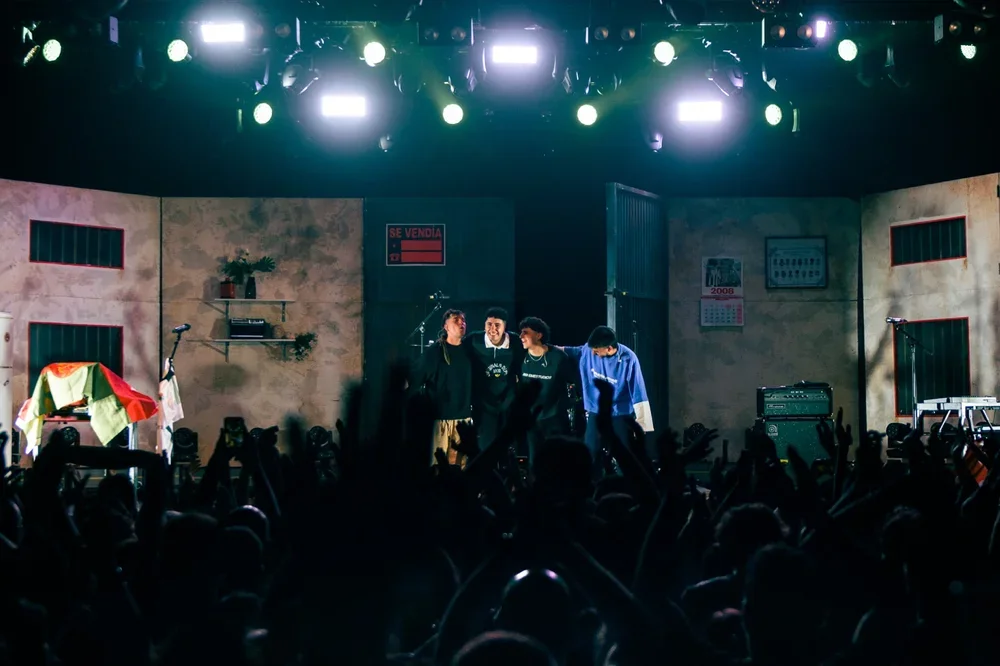
Sanguijuelas del Guadiana sold out three nights at La Riviera
For some, Sundays are peaceful days to enjoy good plans with friends, a hearty family meal, or unwind in the tense calm of the weekend’s last hours. For others, the last day of the week is a painful return to where life ‘forces’ you to be—the place you live but never fully belong. You say goodbye and return. You hug and leave. You go back to that comfort zone that some choose and others impose, where you adapt but to which you never truly belong. Something as unfair as it is common. As sad as it is necessary. Or maybe not? That’s why, for all this and much more, the motto of three ‘young lads’ from Extremadura in ‘Revolá’ makes even more sense when they sing it in Madrid with La Riviera packed: “Lucky you, to be able to live where you were born.” And alongside them, thousands of Extremadurans (and non-Extremadurans) joined in, screaming their voices hoarse over three spectacular concerts.
Víctor in traditional shorts, Carlos in a modern wide-brimmed hat, and Juan with his rasta hair out presented their ‘garage’ at La Riviera with the force of someone fighting for their dreams, proving (once again) that it doesn’t matter what accent you use, but what you’re saying. And if you don’t understand, listen. Sanguijuelas del Guadiana have earned the right to be heard by being themselves (and for all those who were marginalized because of where they came from). They’ve achieved this by centering their discourse on love for their land: Casas de Don Pedro (Extremadura).
**A bond that unites and generates loyalty**
“Ayo, these guys were at my town’s festival, they’re a bunch of jokers,” said some fans at the concert door. “Besides, Víctor and Carlos are calmer, but Juan, the one with the dreadlocks, is a wild one… But he’s all good people,” added others about the band members. The closeness of Sanguijuelas to their audience is exactly what they naturally exude. Far from the big egos of today’s music, Carlos, Juan, and Víctor sound and are well-liked because of their way of being and playing. They’re normal guys who are beginning to realize they have something extraordinary, but whose gift doesn’t make them feel superior to anyone. And that shows. Perhaps coming from where they come from helps them maintain that humility.
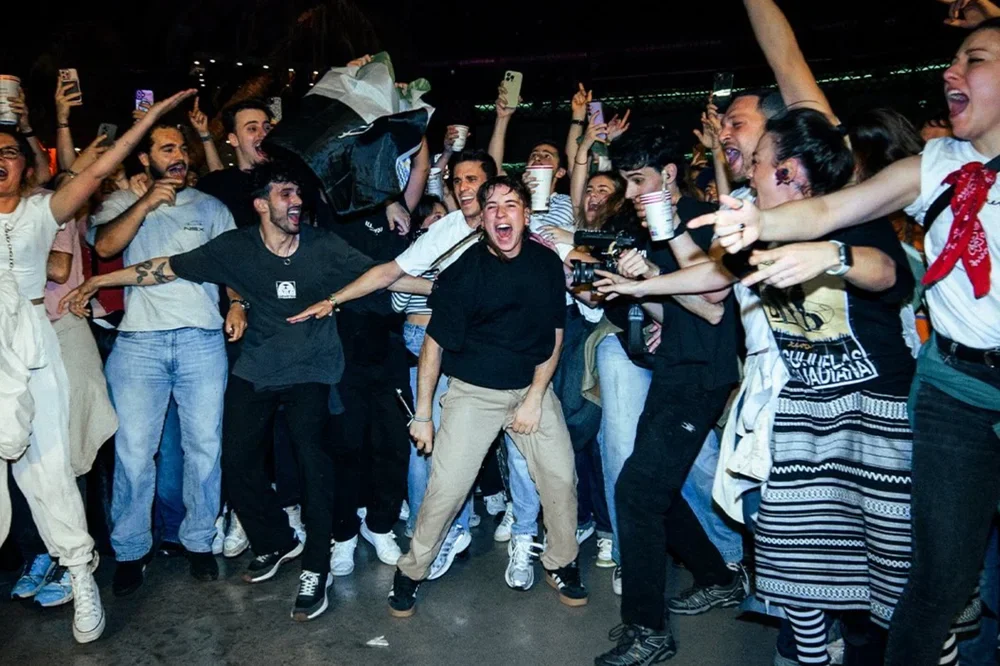
Juan, member of Sanguijuelas del Guadiana, among the crowd
Flags of Extremadura everywhere and local teams in the form of football shirts: CD Extremadura, Badajoz, Cacereño, Don Benito, Chinato, Las Hurdes… It looked like a summer kids’ tournament with players well past the age, where some parent would shamelessly yell at the referee: “Come on, ref! Check the ID.” The atmosphere was deafening, and I’ve rarely seen a merch stand so crowded with fans. Everyone wanted to wear their shirt with pride. And there, in the venue where many other artists have sold out, half of Extremadura waited for their countrymen to create a programmed chaos where no one would be left out in the cold.
**A garage that sold out**
For those who haven’t caught on, in Extremadura only those who don’t want to say ‘garage’—usually out of embarrassment about their origins—say the ‘proper’ word ‘garaje’. And more than a place to park cars, it’s a meeting spot, a gathering place, a celebration, a debate… but also a rehearsal space—the nerve center for many bands to play while enduring complaints from some fussy neighbor. Well, the Sanguijuelas brought their village garage right into the heart of Madrid. The place where everything begins and ends. “What’s up, Madrid! Those of you from villages know what this means,” they said, pointing to the stage. And that was enough. Because even those not from villages also shouted.
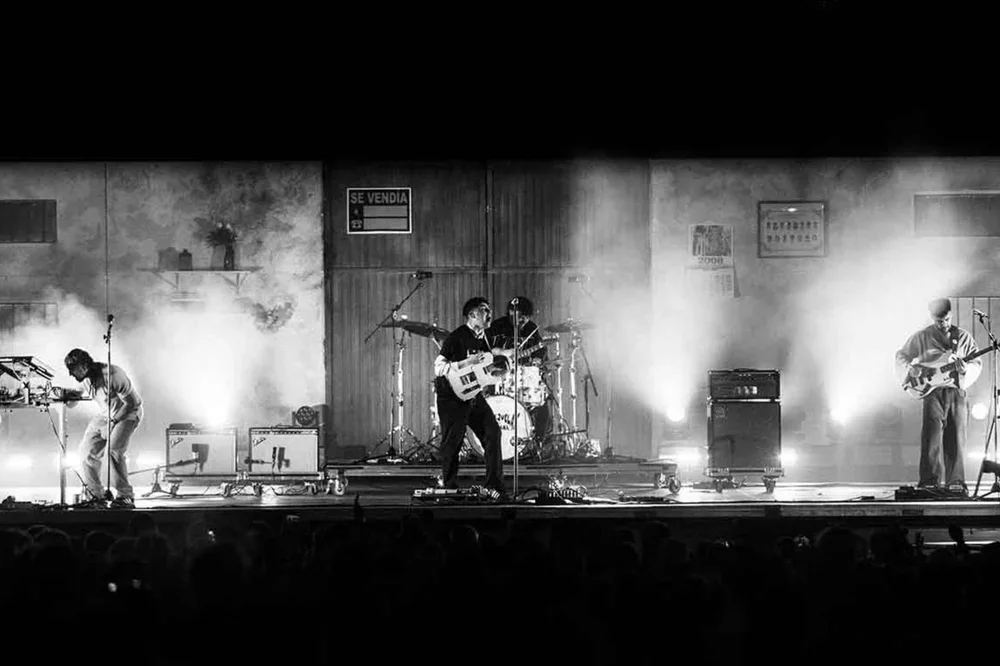
The garage is key to the band’s stage design
The chords of ‘100 amapolas’ burst out abruptly, and Carlos’s raspy voice, swaying with his guitar, synchronized with the necks of thousands of people singing loudly. La Riviera’s adjusted acoustics turned the audience into a choir, and those in the front rows were still amazed to have their idols so close. “We are Sanguijuelas del Guadiana, and we come from Siberia Extremeña. When we released the tickets, we thought they wouldn’t sell at all. So, thank you all,” said Juan, sighing with emotion. The speech didn’t last long, and everything ignited with ‘Yesca’ and its verses between the depth of love and an ode to drinking. Here, Carlos’s wails at the end of the song set ablaze the few who still lacked spark in that room. What intensity. ‘Pa qué me llamas’, ‘Intacto’, and ‘La brecha’ continued without letting the most energetic catch their breath, finally waking up the body with ‘Puñales de plata’.
**Remembering those who deserve it, between wails and emotion**
Thanks to those who deserve it. And if there’s one thing—maybe from simple education or systematic forgetfulness by others—Extremadurans are grateful. Here, everything goes silent for Juan to speak: “Even if you’re not from Badajoz and don’t even know where it is, we’re going to sing it because it’s very easy,” he said with a necessary hint of irony while introducing ‘De Badajoz He Venío’: an emotional anthem to forced migration and the widespread marginalization of ‘La Marelu’. Well, what started as a ‘bland bread’ turned thousands of people into adopted Pacenses jumping uncontrollably.

A staggering musical connection that perhaps overshadowed the importance of that line: “Everyone against me, and me alone with my child. He’s the one who takes away my sorrows and gives me his love”—a clear metaphor and harsh protest against the institutional neglect of an entire region during the post-war period. And among the memories of the past, Robe appeared. Remember: “Either Robe, or Roberto Iniesta. Nothing of Robe Iniesta.” Few are like the singer of Extremoduro and his band to inspire so many, and few places like that garage of Sanguijuelas where Robe himself would smile. “We need more rehearsal spaces,” said the artist from Plasencia in one of his last public interventions. That seemed like a dream come true.
As a tribute, the band from Badajoz sang ‘Nada qué perder’ to the emotion of a devoted audience and the dedication of grateful disciples. “This goes for Roberto Iniesta,” they said sincerely, who now take on the role of the musical emblem of their land.
**A viral live show toward the collective**
If something defines a great live performance, it’s the artists’ ability to drag you into their world, to integrate you into their mind, to convey through their lyrics what they think, and to share through their music what they feel. That ‘rustic rock’ that mixes guitars, rumba, electronics, and memory works because it doesn’t try to fit anywhere. It works because it’s honest. Juan jumping into the crowd, Carlos pacing the stage non-stop, Víctor holding the rhythm with disarming naturalness. And in the middle, a flag of Extremadura hanging from the microphone as a constant reminder that all this comes from somewhere, and they’re proud to share it with the world.
The concert progressed through that mix of party and emotion that few bands manage to balance (perhaps ‘La Pegatina’ or ‘La Raíz’). There was even room for the unexpected, like an unreleased song with urban rock vibes pointing to what’s to come. But even that didn’t break the night’s thread. Because everything revolved around the same thing: where you come from and why that matters.
**The phenomenon that no longer needs